
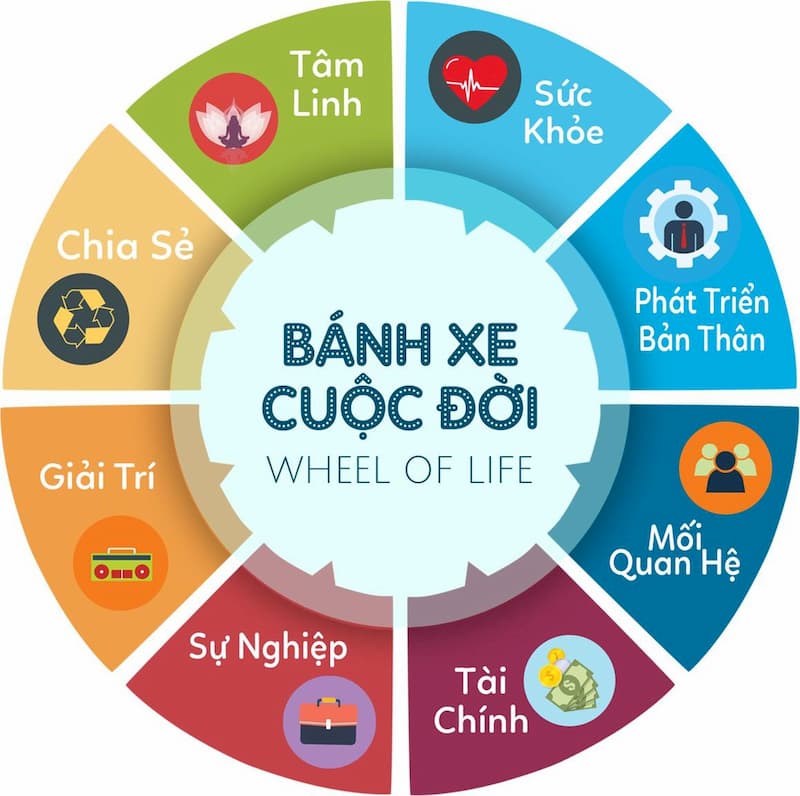
1. What is the Wheel of Life?
The Wheel of Life is a tool that helps individuals assess and discover themselves, including different aspects and issues in life. Many psychological counselors and coaches use the Wheel of Life as an effective solution because of its ability to provide an overview of each person's nature and current situation, draw on information from multiple areas, and help them achieve balance in life more effectively.
2. What factors does the Wheel of Life include?
The Wheel of Life is divided into 6–8 important areas. These include health, career, finances, family, relationships, emotions, personal development, and recreation. These segments represent the factors or values that create happiness in each person's life, according to their different needs and inclinations.
Eight criteria are used, with each segment scored from 1 to 10. The score reflects your level of satisfaction with various aspects of life. A value of 1 is closest to the center, while 10 lies at the edge of the circle. By comparing the scores across these aspects, you gain an overview of your current life.
At the same time, each person can gain a clearer understanding of how they are living their life, recognize what they tend to prioritize, and determine whether adjustments are needed and how to make them.
3. How to use the Wheel of Life
In general, each person should create their own Wheel of Life. The purpose is to build a more complete and balanced life and manage it more effectively. The wheel can be created using the following steps:
Step 1: Draw the Wheel of Life
Divide it evenly into 6–8 sections, depending on each person's categories and individual needs. Choose a quiet time so you can focus fully on creating your Wheel of Life. This will help you assess and view issues as accurately as possible. You can use Wheel of Life templates shared online for reference and adapt them to your own needs.
Step 2: Begin assessing your level of satisfaction
Rate each life criterion or segment on a scale from 1 to 10. At this stage, do not score too quickly; take time to think carefully about every area, including your career, family, personal development, and relationships. Assess and reflect as fairly as possible.
Step 3: Reflect
Once you have scored the life segments, the Wheel of Life will provide an overall reflection of your current life and your level of satisfaction in each area. This helps you identify the problems and difficulties you are facing, as well as ways to address them.

Step 4: Choose the criteria that are most necessary and important in your life
Envision your ideal life and set specific goals. Write them down clearly so they are not forgotten or neglected.
Step 5: Take action
Implement solutions to rebalance your life. Address your current limitations and build on your strengths, while reducing the time spent on factors that distract you. Commit to taking action to achieve the desired results.
Step 6: Review regularly
Redraw your Wheel of Life weekly or monthly to assess your progress and personal changes. Then adjust your actions to achieve your desired goals and maintain balance in life.
4. How can the Wheel of Life be applied to your life?
4.1 For individuals
The factors represented on the Wheel of Life are considered practical and essential for every individual.
The Wheel of Life helps each person better understand their current self. This makes it easier to adjust personal habits and goals, as well as identify methods for improvement.
By looking at the Wheel of Life, we can identify which areas we should focus on developing to create a more balanced life.
The Wheel of Life is also a method that helps us focus on our life goals. It helps us avoid distraction or uncertainty about the things we are striving toward.
Parents can easily support their children in developing the areas represented on the Wheel of Life, helping them build a balanced life from an early age.
4.2 For businesses
Every business has different goals, strategies, and corporate culture. To build a suitable workforce, emotional well-being is just as important as competence and expertise. Emotions often influence people's actions, and not everyone knows how to balance their emotional well-being.
- If employees experience excessive pressure in a particular area for too long, they will find it difficult to meet their work responsibilities. Therefore, applying the Wheel of Life to understand employees can be highly effective. It helps businesses gain a clearer understanding of employees' essential needs, enabling them to provide appropriate and reasonable support.
- By recognizing the differences between each person's Wheel of Life, teams can learn to balance and harmonize the needs of their members. This helps reduce conflict within the company.
- Individuals within the company gain a clearer understanding of their colleagues' needs and wishes, making it easier to provide support and strengthen solidarity.
- Build a succession team that aligns with the company culture. Develop a suitable employee-training strategy to help staff balance their material and emotional well-being.
5. What to do after gaining clarity about your life through the Wheel of Life
It would be a shame to identify your strengths and weaknesses after the entire process and then stop there. We need to find suitable methods to improve ourselves further. For example:
- Take at least one competency and personality assessment to better understand your current strengths and qualities.
- Explore yourself deeply to understand what motivation is reflected in your Wheel of Life.
- Learn skills to advance further in your work. Your material well-being can improve through learning and accumulating experience.
- Methods for improving emotional well-being include yoga, exercise, and meditation, as well as volunteering, listening, and sharing with those around you.
- Join community organizations or gatherings with colleagues.
6. Assessments you can consider
Choose suitable competency and personality assessments to identify your individual strengths and weaknesses. This helps each person focus on developing effectively and follow a clear path. Some assessments to consider include:
6.1 The Uchida-Kraepelin psychological test from Japan
This is an assessment that measures human psychological characteristics throughout the processes of learning, working, and living. With the UK test, you can recognize psychological changes, identify your lifestyle and working style, and avoid pressure created by yourself or your surrounding environment.
6.2 The Trait-Map report
This is the most detailed report analyzing 25 personality traits that a person typically develops throughout their working life. Through Trait-Map, individuals and businesses can identify personality tendencies, characteristics related to core workplace skills, teamwork abilities, and responses to different situations.
6.3 The DISC assessment
DISC divides human personalities into four main groups with different characteristics. Through the test, we can identify our dominant personality traits, determine what type of work suits us, and learn how to improve ourselves.
With these assessments, we can learn how to identify appropriate methods for improving and balancing our lives.
7. Contact Quest Today for Advice on Competency Assessment Solutions!
- Hotline: 1900.6135 (press 2)
- Website: www.vienquest.com
- Fanpage: www.facebook.com/vienquest
- #vienquest #vien_quest #doluongnhansu #do_luong_nhan_su #doluongnangluc #do_luong_nang_luc