
Employers need to know this now so they can stop agonizing over constant staff turnover!
Why do employees quit almost immediately after being hired? Why do “they” seem great during the interview but turn out to be terrible once they start working? Why? Why? Why?

People are the decisive factor in every field!
A company’s strength is clearly reflected in its workforce. That is why the employer’s role is so important. In addition to finding people who fit the job, strategy, and company culture, time pressure is another factor that makes finding the right employees increasingly difficult.
Constant employee turnover costs businesses a great deal of time and money in training. Some positions require 4–5 rounds of recruitment and take nearly an entire year to stabilize.
According to statistics from JobStreet Vietnam, 84.7% of working people feel discouraged about their jobs, while 60% of graduates work outside their field of study. These figures alone make it easy to see whether employees genuinely enjoy their work.
Some people perform exceptionally well during interviews and probation. Once they become permanent employees, however, they are frequently late, work slowly, and make numerous mistakes, … No company wants that. We all want to hire someone truly energetic for a sales position and someone highly meticulous for administrative or accounting work. But how can we know whether a person is suited to the position?
To avoid hiring the wrong people, causing losses for the company, and increasing frustration among both new and existing employees, employers need a way to measure candidates’ capabilities and suitability. This is especially important today, when most candidates prepare thoroughly enough to pass the interview stage.
Hire Right – Put Talent to Work Immediately
There are currently many assessments around the world that help identify human capabilities and personality traits. Each method has its own advantages. Fingerprint biometrics can help measure a person’s strengths and innate instincts. However, these factors may change considerably through learning and work and are also heavily influenced by the external environment. Other assessments, such as MBTI and DISC, consist of a series of questions designed to identify a person’s tendencies. However, participants often answer these questions rather subjectively.
In addition to the methods above, the Uchida-Kraepelin (UK) test is also widely used to identify psychological changes, measure capabilities, and predict patterns of human activity. The UK test involves numerous very simple addition calculations (using numbers from 0 to 9). One advantage of the UK test is that it is easy to administer and apply on a large scale; even children can take it, provided they know how to add numbers.

Although it is simple, the test fully engages participants throughout the process. Their thinking becomes 100% focused. As a result, its diagnostic findings are highly objective and accurate. The way each participant performs during the test reflects part of their everyday habits.
From the UK test results, employers can determine:
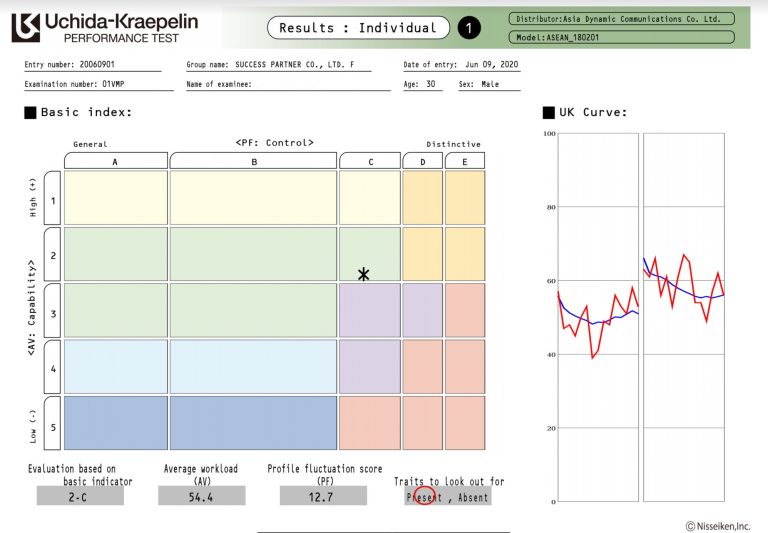

- The general psychological characteristics of employees
- Learning productivity and ability to take on work including the volume and level of accuracy. From these assessments, employers can determine how much workload a candidate can handle and offer an appropriate salary.
- Understand a candidate’s learning and working style. A candidate may start rather slowly but demonstrate great perseverance, making them well suited to roles such as customer service, administration, or human resources. Alternatively, a candidate may get started very quickly but soon become bored, in which case creative work may be more suitable.
- Understand what candidates enjoy and what suits them. Employers can then rotate personnel appropriately and match the right people with the right jobs. This prevents work from stagnating and improves both productivity and quality. It also helps the company save considerable time and training costs.
- Measure unusual psychological changes that may arise from pressure or the living environment, allowing preventive or corrective measures to be taken at an early stage. When candidates and other members of the company clearly understand one another’s capabilities, workplace relationships become more comfortable and harmonious.
In addition, another test that also helps identify suitable candidates is Trait-map. The Trait-map test takes only 15 minutes to complete and is conducted entirely online. Despite its short duration, Trait-map produces highly accurate results and is widely used in Europe and the Americas. Trait-map results are primarily based on five main aspects:
- Social behavior
- Focus on work
- Emotional dimension
- Openness
- Burnout risk

Scores from these five aspects clearly reflect candidates’ tendencies in how they act at work, as well as in social activities and the relationships around them. In particular, the “Burnout Risk” aspect, available only in Trait-map, enables recruiters to understand candidates’ ability to balance work and personal life so they can place them in positions suited to their capabilities.
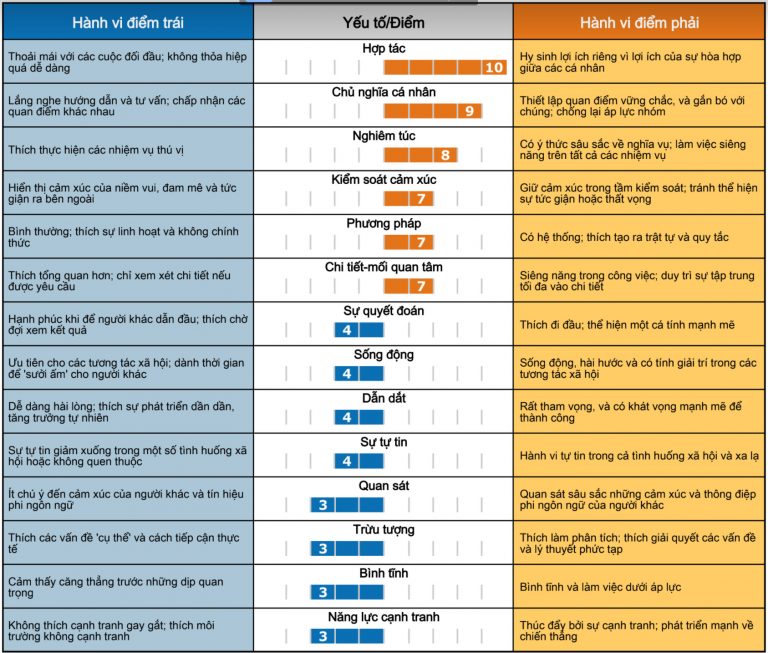
Based on those same five traits, Trait-map provides detailed feedback on 25 types of personality characteristics. By reviewing the results table, recruiters can identify candidates’ strengths and find an environment in which they can flourish, as well as identify their weaknesses and find ways to improve them. The test results are far more accurate than subjective impressions formed during an interview.

Once employers identify personality tendencies, they can clearly understand whether the role is suitable for a candidate and aligned with their natural inclinations. If a candidate is optimistic, cheerful, open, and a confident communicator, why hire them to spend their days working through accounting records instead of trying them in customer service or service consulting? Conversely, if a candidate is reserved, meticulous, and consistently thorough in their work, why recruit them for a sales position?
Whether using UK or Trait-map, conducting psychological and capability assessments is like helping employers “X-ray candidates”, revealing qualities that are already present but rarely visible under normal circumstances. These assessments do not define who candidates are or label them as good or bad, capable or incapable. They simply help us determine whether a candidate is a suitable fit, allowing salary, position, and role decisions to be made more accurately.
Stop wasting resources on unsuitable employees now
People are always rushing around trying to cure illnesses, but few pay attention to preventing them from the outset. Mild illnesses are easy to overcome. But some illnesses show few outward symptoms and quietly persist. We may also keep putting things into our bodies that are inherently unhealthy; over time, they accumulate and cause disease. By the time we discover it, it is already too late!
The health of a business is no different. Hiring one person for the wrong position may not have much impact. But what happens to that business if 10 people are hired for the wrong roles? And what if those 10 people have capabilities worth a salary of 10 million, but the company pays them 15–20 million per month?

This makes it clear that hiring the wrong people not only costs a company considerable training time but also results in an enormous waste of money.
Building and sustaining a business in today’s volatile environment is already immensely challenging. When faced with change and crisis, every company struggles to balance revenue and costs. Hiring the right people can save a company VND 50–100 million in monthly expenses and potentially multiply its revenue by assigning employees to the roles that best suit them.
What recruiters in particular, and companies in general, need to do right now is find and apply assessments that measure employee capabilities and help optimize business operations.