
90% of Employees Quit Because of Their Boss
Assess your company’s potential not through its capability profile, but through its workforce

Employees play an important role in building a company’s brand.
According to a McKinsey survey, most business leaders believe that developing employee capabilities must always be aligned with the company’s growth strategy. Many companies are willing to invest heavily in further professional training for their employees. However, many others still have no specific goals or plans for this. These issues often lead to situations such as:
- Taking far too long to complete assigned tasks
- Completing tasks merely for the sake of appearances
- Laziness and procrastination
- Reluctance to contribute ideas
- Disagreements and internal conflict
- Starting with great enthusiasm but gradually losing motivation
- Uneven allocation of work, with some employees having too little and others too much
Irresponsible employee behavior can cause enormous losses for a company, affecting not only its reputation and brand but also its revenue and costs. The main causes of difficulties in workforce management and operations are often:
- Managers do not fully understand employees’ capabilities and assign the wrong people to the wrong jobs
- Managers do not understand employees’ workloads, leaving them constantly “overloaded”
- Colleagues do not understand one another, leading to frequent conflict, poor cohesion, and resentment over workloads
Yet these problems can be anticipated, and businesses need to find solutions as early as possible. The key is to gain a clear understanding of the capabilities and qualities of the existing workforce, then use that insight to make sound decisions about how to deploy these resources.
Where should you begin if you want to change how you manage your workforce?
There are currently many assessments around the world that help identify human capabilities and personality traits. Each method has its own advantages. Fingerprint biometrics can help measure a person’s strengths and innate instincts. However, these factors may change considerably through learning and work and are also heavily influenced by the external environment. Other assessments, such as MBTI and DISC, consist of a series of questions designed to identify a person’s tendencies. However, participants often answer these questions rather subjectively.
In addition to the methods above, the Uchida-Kraepelin (UK) test is also widely used to identify psychological changes, measure capabilities, and predict patterns of human activity. The UK test involves numerous very simple addition calculations (using numbers from 0 to 9). One advantage of the UK test is that it is easy to administer and apply on a large scale; even children can take it, provided they know how to add numbers.

Although it is simple, the test fully engages participants throughout the process. Their thinking becomes 100% focused. As a result, its diagnostic findings are highly objective and accurate. The way each participant performs during the test reflects part of their everyday habits.
From the UK test results, employers can determine:
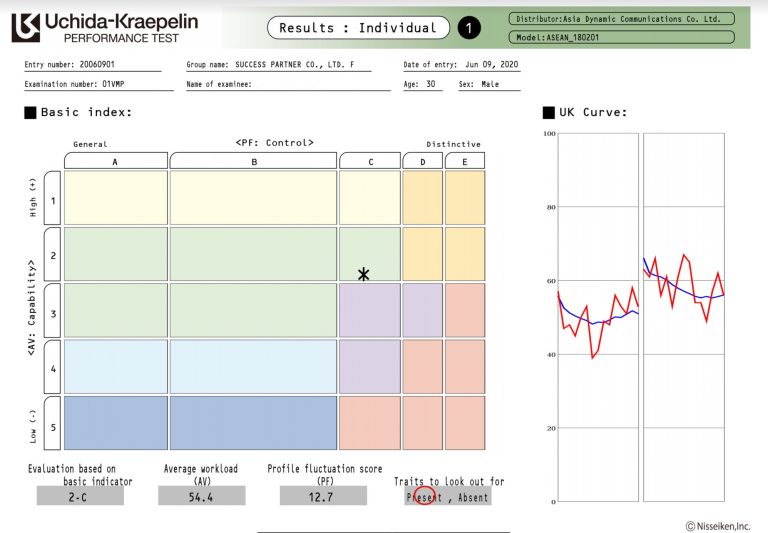

- The general psychological characteristics of employees
- Learning productivity and ability to take on work including the volume and level of accuracy. From these assessments, managers can understand employees’ workload capacity and assign an appropriate amount of work.
- Understand a candidate’s learning and working style. An employee may start rather slowly but demonstrate great perseverance, making them well suited to roles such as customer service or administration. Alternatively, an employee may get started very quickly but soon become bored, in which case creative work may be more suitable.
- Understand what employees enjoy and what suits them. Managers can then rotate personnel appropriately and match the right people with the right jobs. This prevents work from stagnating and improves both productivity and quality. It also helps the company save considerable time and training costs.
Measure unusual psychological changes that may arise from pressure or the living environment, allowing preventive or corrective measures to be taken at an early stage. When employees and other members of the company clearly understand one another’s capabilities, workplace relationships become more comfortable and harmonious.

The UK test can also help analyze a team’s human resource map. After reviewing and clearly understanding the results, managers can assess the team’s current strengths. To operate effectively and maintain stability, the team needs a balanced distribution of working styles. With team results like these, managers can identify not only which employees have been assigned unsuitable work, but also precisely what capabilities and tendencies future hires should possess. As a result, upcoming recruitment will require less time and money.
In addition, another assessment that helps identify capabilities and behavioral tendencies is Trait-Map. The Trait-Map assessment takes only 15 minutes to complete and is conducted entirely online. Despite its brevity, Trait-Map produces highly accurate results and is widely used in Europe and the Americas. Trait-Map results are based primarily on five key aspects:
- Social behavior
- Focus on work
- Emotional dimension
- Openness
- Burnout risk

Scores from these five aspects clearly reflect employees’ tendencies in how they act at work, as well as in social activities and the relationships around them. In particular, the “Burnout Risk” aspect, available only in Trait-map, enables managers to understand employees’ ability to balance work and personal life so they can assign them to positions suited to their capabilities.
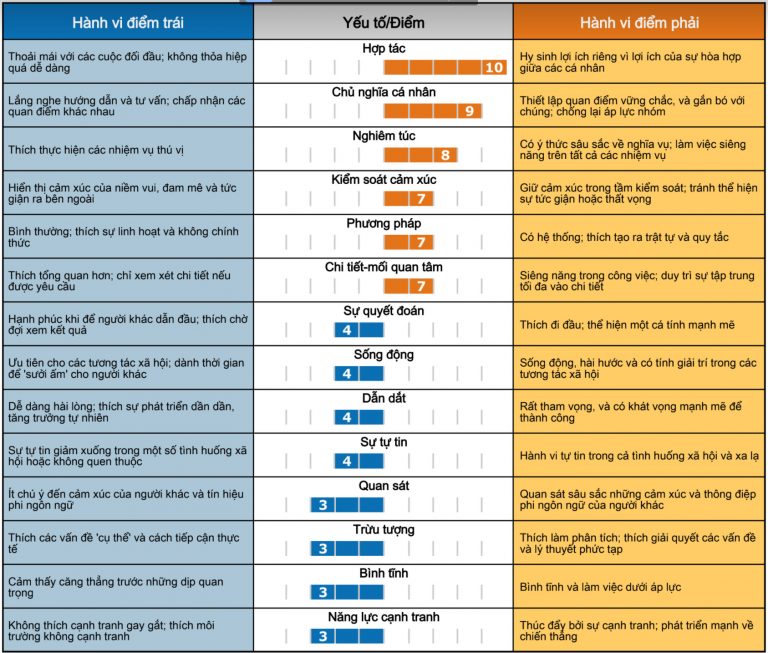
From those five traits, Trait-Map provides detailed feedback on 25 types of personality characteristics. By looking at the results table, employers can identify employees’ strengths and find an environment in which they can flourish, while also understanding their weaknesses and finding ways to improve them. The assessment results are far more accurate than subjective impressions formed during the course of working together.

Once managers identify personality tendencies, they can clearly understand whether an employee’s current job is suitable and aligned with their natural inclinations. If someone is optimistic, cheerful, open, and a confident communicator, why hire them to spend their days working through accounting records instead of trying them in customer service or service consulting? Conversely, if an employee is reserved, meticulous, and consistently thorough in their work, why recruit them for a sales position?
Whether using UK or Trait-map, conducting psychological and capability assessments is like helping managers “see inside their employees”, revealing qualities that are already present but rarely visible under normal circumstances. These assessments do not define who employees are or label them as good or bad, capable or incapable. They simply help us determine whether an employee is a suitable fit, allowing salary, position, and role decisions to be made more accurately.
Immediately reduce risks from within your business

Subjective judgments and decisions often bring considerable risk. When leaders and managers hastily assign work without fully understanding employees’ potential, the results frequently fall short of expectations. Employees who are given work that does not match their capabilities and strengths will also become discouraged. If this situation persists, the entire team, department, and company will become stagnant and inefficient.
The immediate priority is to assess the entire workforce so managers can quickly gain an early understanding of the company’s current state. This makes it possible to adjust strategies and operations promptly, strengthen employee capabilities, and enhance the company’s competitiveness in the market.