

Trait-Map là bộ công cụ rất tuyện vời, giúp đo lường tính cách cũng như tố chất của một con người đến từ Đức.
This is the answer to the question “who are you” or “who you truly are.” Choosing Trait-map® is like choosing a “key” suitable. It helps you understand yourself based on results from the Big Five model. This model reflects five defining personality traits of an individual: Openness, conscientiousness, extraversion, agreeableness, and sensitivity. Trait-map helps identify participants’ personalities and recognize their visible and hidden personality types, as well as their perspectives on life and work, with clarity.
1. What is interesting about the Trait-map® Report?
Thanks to its practical applications, the Trait-Map® report helps recruiters identify promising candidates. It also helps businesses restructure and provide specialized employee training. Today, it is one of the four OD-TOOLS instruments known and used across 21 countries by 28 million users over the past 19 years.
Trait-Map uses different types of questions to place respondents in specific contexts. The questions are cross-referenced and interwoven. The assessment system also controls response times. This encourages respondents to be honest and serious throughout the process.
According to many scientific studies, a person’s personality is shaped by two factors: biology (heredity) and living environment. These two factors play important roles and influence the development of each Big Five factor. This demonstrates that a person’s personality characteristics can change, but their personality itself does not.
2. Where did Trait-map® OD-TOOLs originate?
OD-Tools was created by highly experienced experts from Germany. It has been proven in practice across a wide range of industries worldwide. Authorized Partners are certified to ensure they can provide you with the best possible support.
Built on a foundation of psychology, Trait-Map balances theory with practical application. Although simple and easy to use, it offers analytical depth.
3. Key people behind Trait-Map OD-TOOLs (also known as the Trait-Map test)
Chief Executive Officer: Gabor Nagy. Gabor has 15 years of experience in assessment, training, consulting, and OD. He holds a postgraduate degree in Organizational and Human Resources Management.
Co-founder and assessment author: Friedemann Demmer. A master's degree holder in applied psychology, Frieder has delivered 800 assessment projects. He has more than 15 years of experience in assessment and human development.
CTO: Peter Peto. Peter has more than 20 years of experience developing and operating large-scale enterprise systems.
The online tools were developed by Gabor Nagy, Friedemann Demmer, Vivian Guo (PhD), Fang Hua (PhD), and Daniel Smith, in collaboration with developers from the University of Cambridge Centre for Psychology: Kaori Takenaka (PhD), Fiona Chan (PhD), and Michal Kosinski (PhD).
4. How does Trait-Map analyze personality?
To help you understand who you are at present, Trait-map® provides an assessment based on the first five factors/aspects: (1) social behavior, (2) work focus, (3) emotional aspects, (4) openness, and (5) risk of burnout (a unique aspect that no other tool has been able to measure).

Based on these five aspects, you will gain a clear view of your behavioral tendencies at work, in social activities, and in the relationships around you. The “burnout risk” assessment helps you understand your ability to maintain balance between work and life.
Scores measured according to the Big Five model indicate behavioral tendencies in certain situations. The farther a score is from the midpoint, the more clearly the tendency is expressed. If your score is around the midpoint, it indicates that you are balanced.
5. What do Trait-Map results say about individual personality tendencies?
Once your personality tendencies are identified, your work-related characteristics become clear. These are natural tendencies that align with your personality. This helps explain why you perform certain tasks very well but struggle with others. Based on these manifestations, you can easily identify your strengths and areas for improvement at work. You may also change your career choices to find a better fit. Choosing the right development environment will help you feel happier, more comfortable, and more successful.

6. Applying Trait-Map to Teamwork
For an individual, it is always important to consider what role they play within a group or organization. This helps you identify your position within the team and confidently capitalize on your strengths. Trait-Map® helps you assess the most prominent expressions in your behavior and personality when occupying a particular role, represented by colored areas. The larger the area, the more prominent that role is within you. Specifically, the roles are divided into three main groups, beginning with directional roles:
- People
- Careers
- Ideas

Each role group includes a detailed analysis of the specific fields associated with it.
When you understand your strengths within the team, completing your work becomes easier. You also gain a better understanding of your colleagues. The team will coordinate more smoothly.
7. Psychological Manifestations Based on Trait-Map Results
Personality has a very clear influence on psychological expressions and on how situations are handled when external or internal conflicts arise. Trait-Map helps you assess four basic types of conflict: (1) forcing, (2) collaborating, (3) avoiding, (4) accommodating. All these types of conflict exist within you. However, depending on the situation, each type may manifest with varying intensity. You need to recognize this early because it will help you replace habitual reaction patterns with better, more conscious choices.
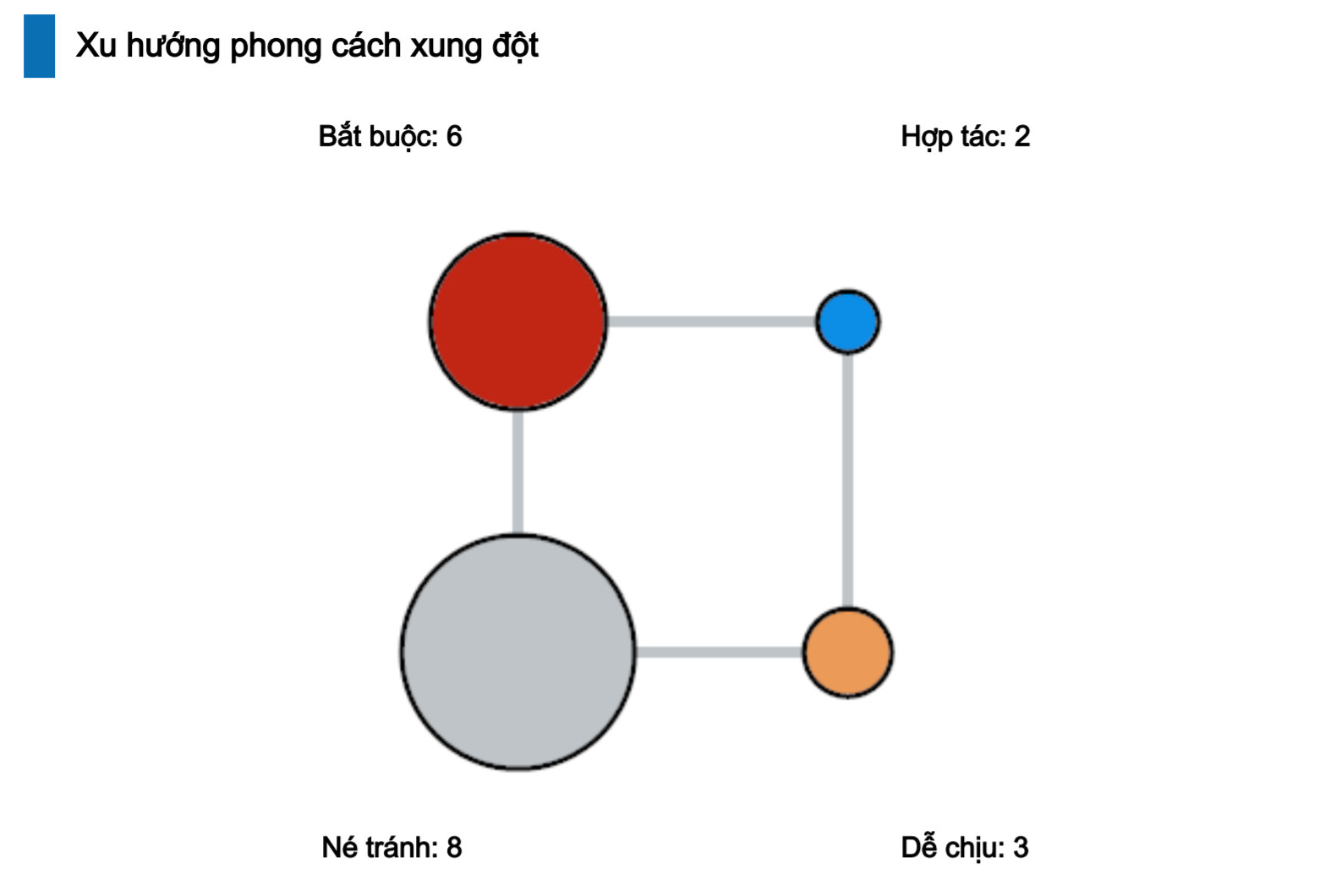
The report analyzes skills based on personality. These include collaboration, negotiation, and presentation, sales ability, and leadership style. This helps us identify strengths and weaknesses in each skill through scores. As a result, individuals can better understand themselves, develop, and improve. They can compare these results with their chosen career and assess and adjust the level of fit.
8. How Is Trait-Map Administered?
One advantage is that Trait-map® is completed online on a computer. It takes only 10–15 minutes and can be completed anywhere with a Wi-Fi connection. Participants can complete it in a comfortable setting without feeling pressured or confined. Online administration is also very convenient for remote employees. A report is returned just minutes after the test is completed, so businesses do not have to wait long for assessment results.
Trait-Map consists of a sequence of questions arranged by priority. You simply read them and arrange them according to your preferences.
To help you better understand Trait-map®, we offer several analyses based on the image below:
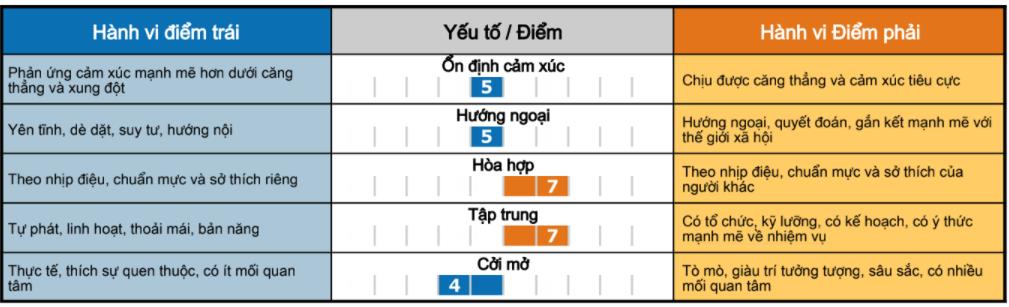
Based on the analysis image above, we can easily see that this person tends toward introversion, with the scales leaning to the left. Would they therefore be better suited to stable, detail-oriented work, or to diplomacy and customer service?
9. Conclusion
In summary, Trait-map® gives both human resources professionals and businesses a clear view of individuals and organizations through group reports. It provides measurements of the skills required for a job. For recruiters and managers, people-related challenges can be addressed accurately and in detail. Based on these indicators, recruitment, appropriate transfers, and specialized training become much more effective.
When all individuals are assessed together in a group report, businesses can easily identify gaps in their workforce. These are definite weaknesses that need to be addressed immediately. This helps limit mistakes in evaluating and utilizing people.
You may also refer to the additional assessment Uchida-Kraepelin from Japan, used to determine employees’ work capabilities.
Contact Quest today for consultation on capability measurement solutions!
- Hotline: 1900.6135 (press 2)
- Website: www.vienquest.com
- Fanpage: www.facebook.com/vienquest
- #vienquest #vien_quest #doluongnhansu #do_luong_nhan_su #doluongnangluc #do_luong_nang_luc