
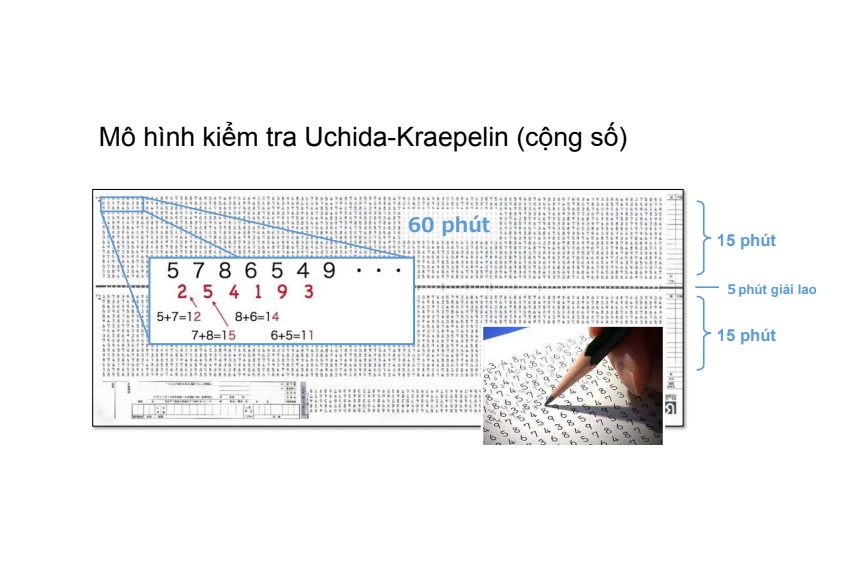
UCHIDA-KRAEPELIN This test was researched and developed by a Japanese psychiatric institute. The Uchida–Kraepelin psychological test was developed in Japan by Professor Yuzaburo Uchida (1894 – 1966). He was inspired by the research of German psychiatrist Emil Kraepelin (1856 – 1926). Since then, the method has continued to be developed in Japan and many other countries around the world.
1. What Is the Uchida-Kraepelin Test?
The Uchida–Kraepelin Psychological Test, abbreviated as the UK Test, is an empirical assessment method. It reflects a person’s ability to use and control their capabilities. Each participant needs 60 minutes to complete the assessment. The results evaluate the participant’s intelligence, abilities, work style, and behavioral characteristics.
The Japanese Institute of Psychiatry and Technology was founded in 1947 by Yuzaburo Uchida. He developed the Uchida-Kraepelin test. The institute has made many contributions to researching and disseminating this test.
Today, the Japan Mental Health Research Co., Ltd. (abbreviated as “Nisseiken Inc”) provides a range of psychiatric services applied in fields such as industry (business), education, and healthcare. The Uchida-Kraepelin Psychological Test is one of the company’s strategic solutions today. The test is continuously improved scientifically and can provide detailed insights with a high degree of accuracy control. In Vietnam, the UK Test was introduced to the public by Quest Academy. The tool has attracted and continues to attract considerable interest from partners and businesses.
2. Methods for Assessing Capabilities and Personality:
Today, there are many methods for assessing (or predicting) personality and human capabilities. Each method has its own characteristics, strengths, and weaknesses, so no tool can be considered inherently superior. Here, we only list the methods and describe the uses of each. The choice of method depends on the user’s purpose.
2.1. Fingerprint Biometrics:
Helps each person recognize their own potential from an early age. However, if a person’s intelligence does not have the opportunity to be trained, inspired, and developed, and is affected by their living and learning environment, it can easily fade and change. By analyzing fingerprint biometrics, we can accurately understand the distribution and number of cells in the left and right hemispheres of the brain to predict where a person’s potential lies and in which fields, thereby creating an optimal educational roadmap for them.
2.2. Determining D.I.S.C. Personality:
This is a fairly common personality prediction tool today. It is widely applied in human-resource management, recruitment, personal development, and team development. With DISC, participants understand the strengths and weaknesses of their personality style, improve their ability to read others, and develop life and work skills. However, the results are statistical and not detailed.
2.3. Trait-map® (1 of 4 measurement tools from OD-TOOLs):
This method identifies behavioral and personality characteristics at work through the application of a scientific and technological platform. Trait-map® focuses on determining the participant’s current personality profile. It then provides short- and long-term strategies for individuals, businesses, and organizations. It is also a measurement tool used in recruitment for potential and important positions within a company.
2.4. Uchida-Kraepelin:
By simulating work performance in 60-second intervals, the UK Test measures work performance, personality habits, and behavioral tendencies through test completion, as well as noteworthy psychological fluctuations. The UK Test is widely used in recruitment, training, personnel screening, and employee and organizational health assessments. It is especially valued in healthcare, transportation, and education—fields that require high levels of safety and accuracy.
3. How Is the Uchida-Kraepelin Test Administered?
The test is administered offline in a fairly simple manner: test takers add consecutive pairs of numbers using a pencil. Guided by a video and a facilitator, each employee can complete the test in just 30 minutes, and the report is available 30 minutes after the test is completed. The test delivers highly objective and scientific results.
4. How Should the Test Results Be Read?
The UK Test shows businesses:
- Signs and issues in personnel placement and adjustment.
- Whether the balance among individuals within and across organizations is appropriate.
- Work styles or behavioral tendencies, clearly demonstrated in specific situations.
- In particular, an individual’s or organization’s level of resilience and risk of burnout, as shown in a group report.
For example:

The UK report identifies people who are anxious or under work-related pressure because of low performance while carrying a high workload. This can lead to mistakes, delays, and a lack of career development. Projects or tasks may also be repeatedly delayed and deliver limited results.
It also identifies psychological changes that significantly affect work quality, especially in roles requiring safety and accuracy or in long-term, important projects. These factors can affect a company’s revenue and reputation.
5. Advantages of the UK Test
The test is easy to administer to many people at the same time, without cultural or language limitations. It helps businesses save recruitment and training costs, time, and personnel resources. Timely measurement also helps recruiters place the right people in the right positions. Businesses gain detailed insight into each individual and team and can make timely adjustments within each department. Personnel transfers and restructuring are supported by a scientific and objective basis.
Moreover, assessment gives businesses an objective view and a clear understanding of each employee’s capabilities, while employees also recognize their own abilities. This helps ensure that compensation and bonus policies do not create internal disagreements. Employees feel respected and recognized, encouraging them to commit, contribute, and remain with the business over the long term.
6. When Is the UK Test Needed?
If you notice that your business is showing signs of:
– Revenue is not increasing.
– Continuous recruitment.
– Idle or frequently conflicted employees.
– Negative customer feedback about the business.
– A consistently tense workplace atmosphere…
These are signs of an imbalance in the workforce structure. Timely assessment and diagnosis help businesses “rescue” themselves in time. They also improve and raise employees’ awareness through courses and training.
Contact Quest today for consultation on capability measurement solutions!
- Hotline: 1900.6135 (press 2)
- Website: www.vienquest.com
- Fanpage: www.facebook.com/vienquest
- #vienquest #vien_quest #doluongnhansu #do_luong_nhan_su #doluongnangluc #do_luong_nang_luc