
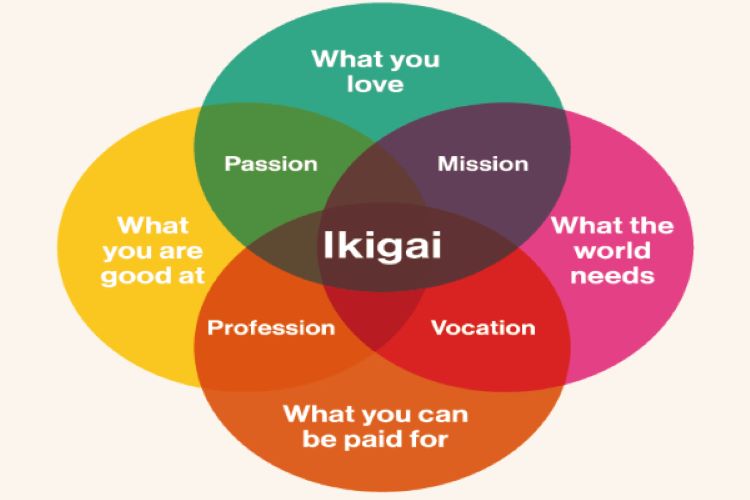
“Ikigai,” a Japanese word that has recently attracted worldwide attention. It is widely used to refer to a passion that brings value and joy to life. The word “Ikigai” is particularly compelling and has implications for people’s mental and physical well-being.
I. What is Ikigai?
Ikigai is a Japanese concept meaning your “reason for living.” Your Ikigai is your purpose in life or your source of happiness. It is what brings you joy and inspires you to get out of bed each day.
1. Where did Ikigai originate, and why has it become so popular?
The Japanese philosophy of Ikigai dates back to the Heian period, from 794 to 1185.
Okinawa is a Japanese island south of the mainland. It has the world’s highest proportion of people aged over 100, and Ikigai plays an important role in Okinawan culture.
However, this Japanese secret is not only relevant to older people. It is becoming increasingly popular among younger generations both in Japan and abroad—people who are interested in having a meaningful working life.
2. The 04 elements that make up a person’s Ikigai
- What do you love?
- What are you good at?
- What can earn you money?
- What does the world and society need?
None of these 04 elements alone is your Ikigai. They intersect with one another. The center of the diagram, where these elements overlap, is your Ikigai.
II. Why is finding your Ikigai important?
Japan ranks second in the world for life expectancy; women are expected to live 88.09 years and men 81.91 years. While diet certainly plays an important role, many Japanese people believe that Ikigai has a great deal to do with their longevity and happiness.
Knowing your Ikigai can help you:
- Design your ideal working lifestyle
- Build strong social connections in the workplace
- Create a healthy work–life balance
- Pursue your career dreams
- Enjoy your work
When you know your Ikigai and understand its meaning, you align the work you want to do with the work the world needs you to do.
III. Steps to find your Ikigai
1. Answer questions about the 04 elements that make up each person’s Ikigai.

1.1. What do you love?
At work:
- Are you absorbed in your work?
- Are you more excited about going to work than leaving it?
- What is the connection between your emotions and the results of your work?
If you have a hobby or craft:
- Do you enjoy it even when you feel you can never learn enough?
- Are you more excited about your hobby or craft than anything else?
- Do you feel emotionally connected to your hobby or craft?
1.2. What are you good at?
If you are currently working:
- Do people ask you for advice on topics related to your work?
- Are there parts of your work that come easily to you?
- Are you one of the best at what you do?
- Would you like to become an expert in what you do?
If you have a hobby or craft:
- Do people compliment you on your hobby or craft?
- Are you one of the best at your hobby or craft?
- Would you like to become an expert in your hobby or craft?
1.3. What can earn you money?
If you are currently working:
- Are other people paid for work similar to what you do?
- Does your work support the lifestyle you want?
- Is there healthy competition for your work?
If you have a hobby or craft:
- Have other people built careers from the same hobby or craft as yours?
- Do people around you want to buy what you make?
- Is there healthy competition for what you do?
1.4. What does the world need from you?
If you are currently working:
- Is your work considered highly in demand in the market?
- Imagine the years ahead: will what you do still be valuable?
- Are you addressing a social, economic, or environmental problem?
If you have a hobby or craft:
- Is your hobby or craft in high demand or sought after in the market?
- Will your hobby or product still be valuable in the future?
- And is that career or hobby addressing a social, economic, or environmental problem?
If you answer “yes” to the questions above, you can continue doing the work you are currently doing or turn your hobbies into your dream career.
2. Reflect and brainstorm to find your Ikigai
Take some time to imagine your ideal day from beginning to end. What are you wearing? Who are you talking to? What are you doing? Pay attention to how you feel. What makes you feel good about your work?
Remember to write down clearly what you imagine.
Next, look at the questions you answered “no” to. Take time to brainstorm and write down small changes you could make. Align them with what you love, what you are good at, what the world needs, and what you can be paid for.
Throughout this process, focus fully on finding your center—your Ikigai.
- For example, if you answered “no” to the question “Are you absorbed in your work?”, you should clearly consider exploring and choosing a different job. Base your decision on the ideal day and ideal job you imagined.
Change always makes people fearful and doubtful. However, it is an inevitable part of life and may become a major turning point or step forward.
3. Research and learn to find your Ikigai
You now have an image in your mind of what your ideal working day looks like. Next, consider studying, conducting research, taking classes, or hiring a coach or mentor. This step can help you discover whether your vision meets your real-life expectations.
For example, you may want to become a wedding photographer. However, after being mentored by a professional wedding photographer, you may realize that it is not for you.
If you go through this process and find that your vision meets your real-life expectations, it seems you have found your Ikigai.
If not, don’t worry. Repeat steps one to three with another job, hobby, or craft until you find your Ikigai. If you still cannot find it, consider starting and experimenting with various roles.
Note: Finding your Ikigai does not mean that you will love every aspect of your career. It means that you are willing to accept even the less-than-perfect parts because your career aligns with what you love, what you are paid for, and what the world needs.
Next article: IKIGAI AND HOW TO REALIZE YOUR LIFE PURPOSE
Some tools to support the identification of professional abilities, skills, and personality:
- Trait-Map Report (Professional Personality Map)
- Uchida-Kraepelin Test (Measuring Performance and Work Capacity)
- MQ Test (Measuring Work Motivation)
Contact Quest Now for Consultation on Competency Measurement Solutions!
- Hotline: 1900.6135 (press 2)
- Website: www.vienquest.com
- Fanpage: www.facebook.com/vienquest
- #vienquest #vien_quest #doluongnhansu #do_luong_nhan_su #doluongnangluc #do_luong_nang_luc #PESTEL #pestel