
[Based on the Motivation Questionaires – OD Tools report, provided by VienQuest Institute]
Motivation is the source of mental energy and the underlying reason behind human behavior. Motivation is a core value that drives effectiveness at work. Motivation drives us to work every day and encourages us to increase our efforts to complete our tasks.
Almost all of us share the same basic needs that must be met, such as the need for food. However, even when it comes to eating, some people prefer noodles while others prefer rice. Motivation based on these needs works in a similar way: even when people share the same level of needs, the methods and factors that motivate us can be very different.
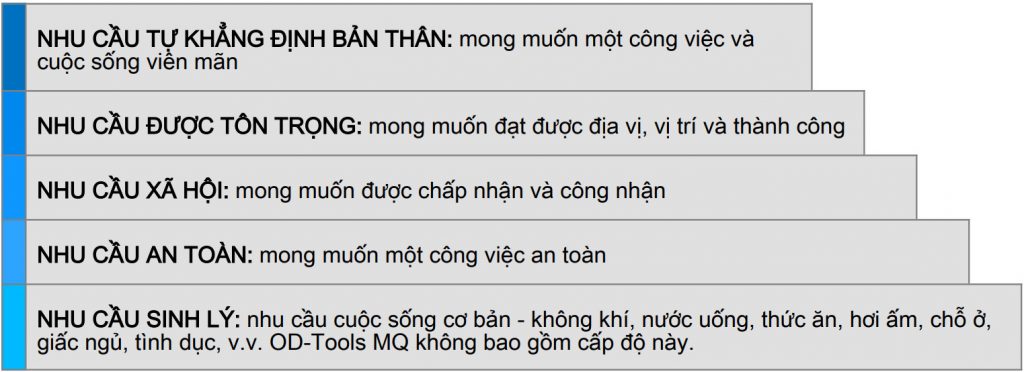
Maslow’s Hierarchy of Needs is a five-level system of needs depicted in the shape of a pyramid. The most basic and largest needs are located at the bottom. Maslow’s theory generally holds that an individual’s most basic needs must be met before they become motivated to pursue higher-level needs.
When a need emerges, emotional tension begins to develop, thereby directing and adjusting human motivation toward satisfying that need. The more lower-level needs are satisfied, the more important higher-level needs become.

Because this series is about motivation as applied in the workplace, VienQuest Institute will temporarily refrain from analyzing physiological needs. Therefore, the remaining 4 levels of needs can be divided into:
– External needs: originate from external factors, other people, and the outside world in general. They include safety needs and social needs.
– Intrinsic needs: come from within each person, such as the emotions you experience while carrying out an activity. Intrinsic motivation is less concerned with immediate external benefits.
By evaluating ourselves with scores on a scale of 10, we can determine the ratio between intrinsic and external needs. Although external needs are relatively clear and easy to understand, intrinsic needs are the common characteristic of successful people. Intrinsic needs can also be understood as the ability to motivate oneself. Through this ability, they can generate enthusiasm and energy to overcome difficulties.

When rating yourself, you can assign scores in two columns. Column A represents the needs you feel must be fulfilled, while Column B represents your level of satisfaction with each need. If the scores in the two columns are equal, or if Column B is higher, it means these needs are being fulfilled. If Column A is higher than Column B—and this warrants even greater attention when it is much higher—it indicates that some of your needs exceed your current level of satisfaction. This gap can create pressure that motivates you to strive, but if it becomes too large, it may cause you stress.
At this point, we need to reassess and reorganize our long-term goals and strategies so that they are appropriate for the pressure we place on ourselves to strive. This is particularly important for maintaining high motivation. In some cases, excessive pressure makes people feel unable to overcome difficulties and causes them to give up from the outset.
For businesses, when this gap creates pressure to strive, we can adjust the work environment, goals, or compensation and reward policies to maintain employee motivation.
Next article: Case study on applying motivation analysis at work to retain employees
– Content Team, VienQuest Institute –
Contact Quest Now for Consultation on Competency Measurement Solutions!
- Hotline: 1900.6135 (press 2)
- Website: www.vienquest.com
- Fanpage: www.facebook.com/vienquest
- #vienquest #vien_quest #doluongnhansu #do_luong_nhan_su #doluongnangluc #do_luong_nang_luc