

Businesses are always looking for ways to retain employees for as long as possible, especially those with suitable capabilities. Employees do the same: they seek a company where they can contribute and build a long-term career. Yet these goals still seem to be a barrier preventing businesses and the right employees from truly finding one another.
That is why businesses regularly face situations such as:
- Employees constantly changing jobs
- Not 100% focused on work
- Always feeling pressured and discouraged when assigned tasks.
- Employees are in conflict and do not support one another
- Declining revenue despite having a clear strategy
- Employees acting out of alignment with the company culture…
And many other issues arise, making it difficult to build long-term employee cohesion, develop a succession pipeline, or promote people into key positions.
To understand their employees, businesses often organize assessment sessions. The purpose is to allow employees to evaluate the company and share what they are satisfied or dissatisfied with. They may even explore employees’ aspirations throughout their time with the business. However, with this approach, employees are often cautious because their personal information is stored. They become guarded and reluctant to discuss the truth they want to share.
In addition, general questions make it very difficult to identify specific issues and employees’ genuine aspirations.
This can render proposed plans and strategies ineffective, leading to wasted time and expense.
So how can we identify what motivates a person?
We can observe and assess them through interaction, observation, and interviews. However, this method still cannot clearly reveal or determine a person’s motivation. All assessments are based on subjective impressions, represent only a one-sided perspective, and lack clear feedback from the person being assessed.
The best way to identify someone’s motivation is to place them in different contexts so we can better understand their choices. This also reveals what they truly care about, what influences them, and what creates pressure for them.
Once we identify a person’s concerns, it becomes easier to adjust their aspirations appropriately or create well-directed development plans.
For example, if we know that someone has a strong interest in and need for money, we can help them achieve their goal or adjust it appropriately.
Today’s market offers several psychological tests that can effectively identify a person’s motivation. However, the motivation test most widely used by businesses in Germany, the United States, Taiwan, Japan, Vietnam, and other countries is the Motivation Questionnaire (MQ) from OD-TOOLs. The test’s advantage is that it clearly shows, through score scales, a person’s motivational indicators based on Maslow’s Hierarchy of Needs (the hierarchy of basic human needs).
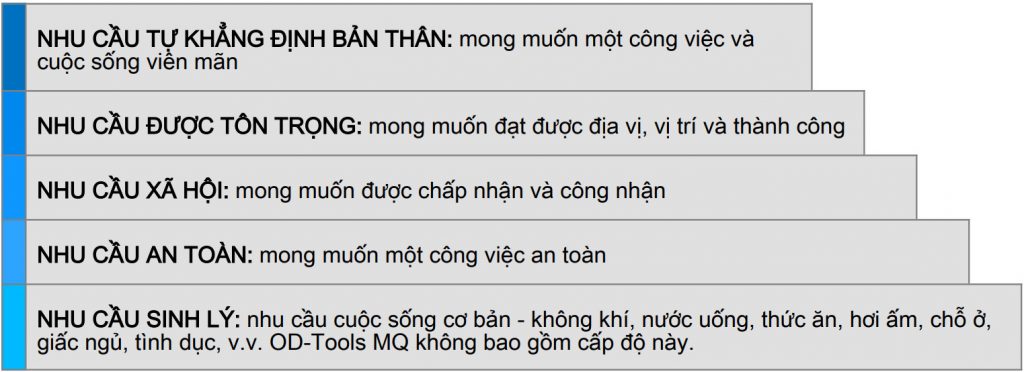
To learn more about the MQ test, see more here: https://vienquest.com/phan-tich-dong-luc-dua-tren-thap-nhu-cau-maslow/
How understanding motivation benefits businesses
The MQ test is designed with a simple, easy-to-understand report featuring pie charts that compare external and internal motivation, along with parallel score scales that reveal the gap between expectations and satisfaction.
The MQ report is easy to interpret. Its indicators show what a person is concerned about. Based on this, businesses can consider and develop more suitable plans for the growth of the company and its employees. At the same time, the results help the company make informed decisions about workforce reduction, screening, or focused training in line with its strategy and culture. https://vienquest.com/mau-thuan-trong-dong-luc-lam-viec-cua-ca-nhan-the-hien-nhu-the-nao/
The circular model is like a mirror reflecting a person’s unspoken concerns. Are they striving for learning, achievement, excellence, or financial growth? How are these concerns connected, and how do they influence one another? How can we improve the fulfillment of these needs as effectively and intelligently as possible? It can even answer questions such as:
- Are they truly a good fit for the company culture?
- What are this person’s worries and sources of pressure?
- What motivates them to work hard?
- Are they suitable for promotion to another position?
- How can we help them maximize their potential strengths?
- …
As you can see, once we recognize a person’s genuine needs, we can develop suitable solutions to address them. For each individual, this means better understanding and striving at work, choosing a more suitable career, setting or adjusting expectations to match their abilities, creating their own motivation, and strengthening discipline to achieve what they want. ttps://vienquest.com/lam-cach-nao-de-tu-tao-dong-luc-cho-ban-than
For businesses, this is the best way to support employee development, strengthen long-term employee engagement with the company, and inspire dedication because employees feel recognized and supported in their growth. It also enables appropriate workforce screening and reduction, promotion to suitable positions, and a lower turnover rate. https://vienquest.com/giam-ti-le-nghi-viec-bang-viec-thau-hieu-dong-luc-lam-viec/
How to build a team through motivation
In addition to individual reports, group reports help businesses identify gaps and determine whether their workforce structure is appropriate. They show how to make changes that drive business growth and help employees achieve their goals. Employees understand and recognize one another, willingly provide support, reduce conflict and unhealthy competition, strengthen employee cohesion, and build a succession team aligned with the company culture. https://vienquest.com/hieu-suat-lam-viec-cua-nhan-vien-anh-huong-boi-yeu-to-nao/
For example, when we identify individuals who are motivated by learning, knowledge development, and challenges, they are well suited to innovative, demanding projects that allow them to excel. Organizing development programs can also motivate them to stay with the company.
For individuals who want to be heard and share with others, and who are not overly concerned with material matters, customer service positions may be a good fit.
How does understanding motivation benefit each individual?
When individuals recognize and clearly understand their needs and aspirations, they can set plans and goals to fulfill them. They can also adjust their aspirations and increase their ability to motivate themselves. https://vienquest.com/lam-cach-nao-de-tu-tao-dong-luc-cho-ban-than/
At the same time, this helps people reduce pressure in both work and life. Balancing needs and aspirations makes life more enjoyable and fulfilling. It also helps them find suitable work and devote time to making an effort instead of repeatedly changing jobs and searching for the right one.
Other examples of motivation
Motivation helps individuals choose suitable career fields and define an appropriate future direction: https://vienquest.com/dinh-huong-nghe-nghiep-va-nhung-sai-lam-thuong-gap/
Workforce screening and selection can always be carried out: https://vienquest.com/cach-toi-uu-hoa-tiem-nang-cua-nhan-vien-trong-cong-viec/
Reducing employee misalignment with the company culture: https://vienquest.com/van-hoa-doanh-nghiep-va-tai-cau-truc-nhan-su/
How leaders can increase employee engagement: https://vienquest.com/cach-de-lanh-dao-tang-su-gan-ket-trong-nhan-su/
Selecting groups of people who are a good fit for the business: https://vienquest.com/nhung-nhom-nguoi-can-co-trong-cong-ty-giup-tinh-gon-nguon-nhan-luc/
To drive organizational and individual development, businesses must pay attention to the forces that motivate each person. They must also identify gaps in workforce management and quickly reshape the organization. Especially when costs need to be tightened, using assessments for accurate measurement is essential.
- Hotline: 1900.6135 (press 2)
- Website: www.vienquest.com
- Fanpage: www.facebook.com/vienquest
- #vienquest #vien_quest #doluongnhansu #do_luong_nhan_su #doluongnangluc #do_luong_nang_luc #dongluclamviec #dongluc