
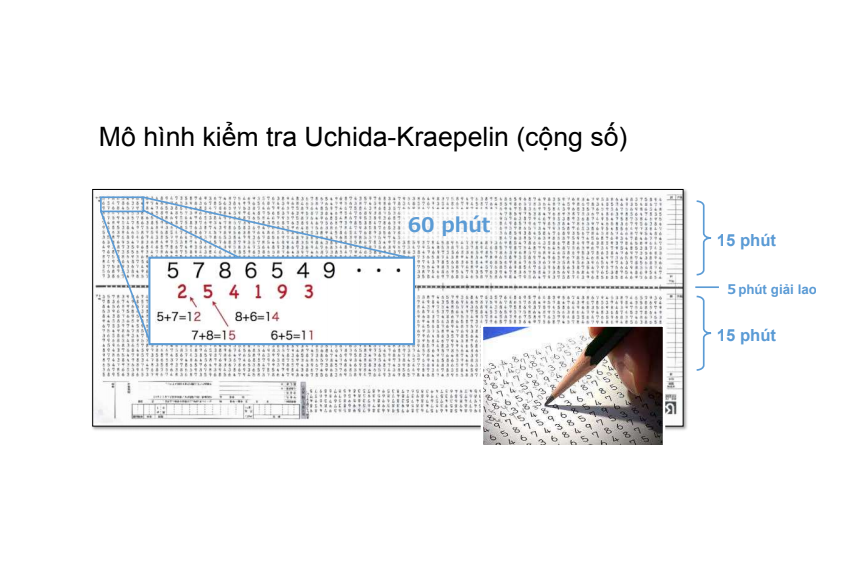
Uchida-Kraepelin Report (UK test) focuses on measuring and diagnosing trends in your work habits, style, and performance, as well as changes in employee psychology. Recognizing these patterns helps reduce work pressure, choose work suited to your capabilities, and acknowledge individual differences within the team.
Based on the report results from the Uchida-Kreapelin test, this assessment is simple yet covers almost every aspect of work. With these results, businesses can minimize vague or inaccurate evaluations of individuals, identify areas for team improvement, and develop strategies, targets, and roles that are better suited to individuals and organizations.
In addition to measuring and identifying 5 different working styles, the UK report also focuses on diagnosing changes in human psychology.
Psychological tendencies diagnosed through the Uchida-Kreapelin report
Psychology is closely connected to other factors related to performance and the creation of motivation at work. It can even affect work skills, reducing employee capacity and impacting the quality of the company.
When concerns remain unanswered or there are things a person is not yet ready to accept, what abnormal psychological changes may occur in employees??
According to the results reported by Japan’s Uchida-Kraepelin psychological test, a person will generally exhibit one of eight warning signs when facing a problem in life or at work.
Eight warning signs of human-related danger/risk. They are as follows:
- Frequent errors: Work involves many mistakes due to a lack of concentration or haste, resulting in inaccurate outcomes
- Impulsiveness: working according to one's emotions—fast at times and slow at others, energetic at times and subdued at others
- Sudden depression: a drop in energy at work, or a need to take breaks such as smoking, drinking tea, or chatting … to regain energy
- Excessive psychological fluctuation: excessive enthusiasm
- Flatness: inflexibility; outwardly, they often appear quite calm and make little impression. At times, they may be indifferent to certain situations.
- Slow to restart: slow to re-engage with work, with little interest or motivation
- Reduced performance toward the end: physical fatigue and reduced willpower. This may be caused by work pressure or the effects of sleep deprivation and poor mental alertness.
- Very low output: the complexity of the work requires time to become familiar with and master it
What should the leader of an organization/company do when an employee displays one of these eight signs?
1/ Build rapport and ask the employee about their work and life.
2/ Offer praise before giving feedback.
3/ Do not create pressure or judge the employee based on their results. Understanding and empathy will help employees strive and develop more effectively than criticism.
4/ Hold sharing sessions within the organization so everyone has an opportunity to be heard, understood, and supported.
5/ Organize meditation or healing programs to help employees strengthen their self-healing capacity and restore their energy.
6/ Organize exercise, sports, and team-building activities to increase vitality and reduce life-related stress. Help employees understand one another better.
7/ Establish monthly, quarterly, or annual reward policies. Recognize employees in front of the team so they feel that their contributions are acknowledged and respected.
8/ Assign a workload suited to their capabilities.
For psychological risks, we need therapeutic remedies for the mind. These help employees resolve their concerns and difficulties. When their worries are addressed, employees will feel more secure in their work.
When is the Uchida-Kreapelin Psychological Report used?
The UK test is highly effective in recruitment, functioning like a nonverbal interview while eliciting the most candid answers. Because the test consists of addition problems and requires concentration, its results are entirely objective and accurate.
In addition to recruitment, the UK test can be used to measure the abilities and habits of individuals within a team, assess teams within an organization, and understand the current state of an entire team. Businesses can also use it for employee training, periodic competency assessments, personnel screening, and assigning employees to roles aligned with the business strategy and culture.
How is the Uchida-Kreapelin Psychological Test conducted?
The UK test is conducted on a standardized sheet of paper using simple addition problems. This does not create limitations or barriers related to national culture or language. It can also be administered simultaneously to many employees, saving businesses time and costs.
Where can you find the Uchida-Kreapelin test?
Uchida-Kreapelin has been widely used in recruitment, with more than 63 million users across 14 countries, particularly Japan. To date, it has been fully adopted for employee recruitment in railway transport, healthcare, and schools..
The test was introduced and became popular in Vietnam in 2019 and is now being offered to businesses through VienQuest Institute.
Contact Quest Today for Advice on Competency Assessment Solutions!
- Hotline: 1900.6135 (press 2)
- Website: www.vienquest.com
- Fanpage: www.facebook.com/vienquest
- #vienquest #vien_quest #doluongnhansu #do_luong_nhan_su #doluongnangluc #do_luong_nang_luc #nhayviec #jobhopping