
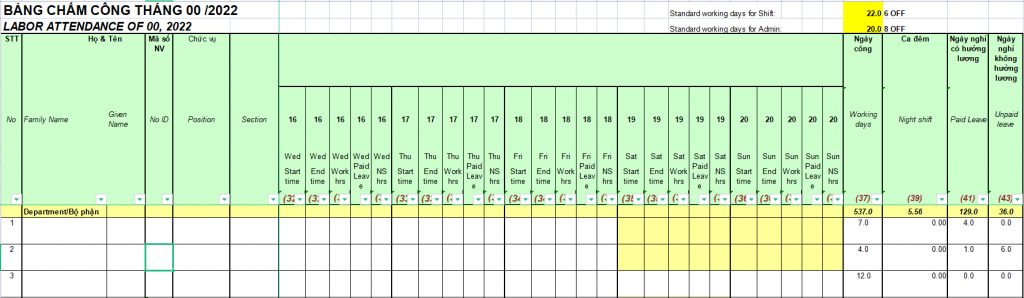
A timesheet is an essential file or software tool for managing attendance. It is used to track actual working days, working hours, annual leave, social insurance leave, and more. This provides the data needed to calculate salaries and bonuses or other employee benefits. Depending on the complexity of workforce management, a business will use a corresponding type of timesheet.
When searching Google for the keyword “Timesheet,” we can find many file templates.

1. Who manages the timesheet?
Depending on the number of employees, either the human resources department or individual departments may be responsible for managing the timesheet.
In companies with a large workforce, each department records attendance for its employees. Attendance may be recorded daily, weekly, or monthly. At the end of the month, the records are consolidated and sent to HR for review before being forwarded to accounting to process employee payroll.
The human resources department must consolidate the files from each department before sending them to accounting.
Today, clocking in and out of shifts requires a card swipe, fingerprint scan, or system check-in. Attendance records must be verified against actual working hours. Working time and overtime, if any, must also be fully recorded. In particular, errors or attendance fraud should be prevented unless the records are reconfirmed through the system.
2. Methods for recording attendance:
Recording attendance by workday. A single code is used for days when employees work. For days when they do not work at the company, a different code may be used, such as BT (Business Trip), or another code according to the timesheet conventions.
Recording attendance by working hours. For shift-based workplaces, managing shifts through check-in and check-out times on the timesheet provides much more detail. Time-based attendance tracking can identify late arrivals and overtime, if any.

3. Common codes used in a timesheet
- OFF: a day off during the month.
- AL (annual leave): annual leave entitlement. This is usually 12 days per year for employees who complete 12 months of service per year.
- PL (public leave): New Year’s Day; Lunar New Year; Victory Day (April 30, Gregorian calendar); International Labour Day (May 1, Gregorian calendar); National Day (September 2, Gregorian calendar, plus one adjacent day immediately before or after it); Hung Kings Commemoration Day (the 10th day of the third lunar month).
- CR (compassionate leave): a compensatory day off. In some businesses, employees still work on a PL day. They will receive a compensatory day off on another day, referred to as CR.
- SL (sick leave): sick leave. If an employee has documentation for social insurance benefits, the company will assist with the procedures for claiming social insurance. The employee will receive certain benefits under regulations for the period they are unable to work due to illness.
- ML (maternity leave): maternity leave
- UP (unpaid): unpaid leave.
- BT (business trip): recording pay for days spent on business trips or performing work away from the company.
These codes may vary considerably depending on each company’s conventions.
Contact Quest Now for Consultation on Competency Measurement Solutions!
- Hotline: 1900.6135 (press 2)
- Website: www.vienquest.com
- Fanpage: www.facebook.com/vienquest
- #vienquest #vien_quest #doluongnhansu #do_luong_nhan_su #doluongnangluc #do_luong_nang_luc #dongluclamviec #EQ #trituecamxuc